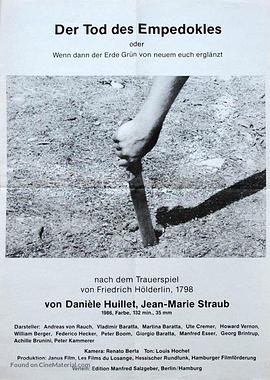
The subject of Danièle Huillet and Jean-Marie Straub’s Der Tod des Empedokles (The Death of Empedocles, 1987) is the Greek pre-Socratic philosopher Empedocles (c. 490 BC – 430 BC), who lived in the Greek colony of Agrigentum in Sicily. His theories are mentioned in several of Plato’s dialogues. He maintained that all matter is made up of four irreducible elements: water, earth, air and fire. A mystic and a poet, he is considered to be the founder of classical rhetoric. He is also thought to be the last Greek philosopher to write in verse; two fragments of his works survive: Katharmoi (Purifications) and Peri Phuseôs (On Nature). An advocate of democracy, he came into conflict with his fellow citizens of Agrigentum and, as result, was banished with his young disciple, Pausanius. When he was asked to return, he preferred to commit suicide by throwing himself into the active volcano at Mount Aetna. The German writer Friedrich Hölderlin wrote two versions of Der Tod des Empedokles in 1798 and 1800, and a final third version in 1820, all three ultimately unfinished. They were conceived as five-act tragedies and all three differ in plot. According to Michael Hamburger, Hölderlin’s English-language translator, the main reason why Hölderlin finished no version of the play must be that he remained too closely identified with Empedocles, at the very period in his life when his own view of the poet as philosopher, prophet and priest – and as tragic hero – was subject to perpetual crisis and re-examination. Huillet-Straub’s The Death of Empedocles is based on Hölderlin’s first version (the longest of the three), whereas Black Sin is based on the third version.
达芙妮·基恩,苏菲·奈丽丝,珀西·海恩斯·怀特,尼克·弗罗斯特,艾丽·斯考比,杨子英,斯蒂芬·卡林,米卡·阿蒙森,迈克尔·科拉斯,贾纳娅·斯蒂芬斯,兰内特·瓦雷,特洛伊·詹姆斯,贾利勒·斯瓦比,蒋如思,朱莉娅·迪扬,Cameron Gordon Norris,Toria Summerville,Louis Adams,梅努卡·萨瓦尔,克里斯蒂娜·萨赫利