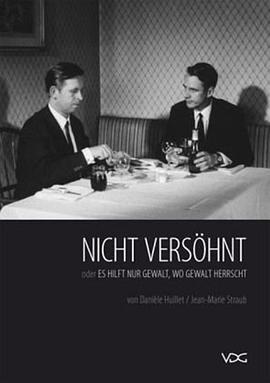
The subtitle of Jean-Marie Straub and Danièle Huillet’s first feature, from 1965, “Only Violence Helps Where Violence Reigns,” suggests the fierce political program evoked by their rigorous aesthetic. The pretext of the film, set in Cologne, is Heinrich Böll’s novel “Billiards at Half Past Nine,” which they strip down to a handful of stark events and film with a confrontational angularity akin to Bartók’s music that adorns the soundtrack. The subtlest of cues accompany the story’s complex flashbacks. The middle-aged Robert Fähmel tells a young hotel bellhop of persecutions under the Third Reich; his elderly father, Heinrich, an architect famed for a local abbey, recalls the militarism of the First World War, when his wife, Johanna, incurred trouble for insulting the Kaiser. A third-generation Fähmel is considering architecture, just as the exiled brother of Robert’s late wife, returns, only to be met by their former torturer, now a West German official taking part in a celebratory parade of war veterans. Straub and Huillet make the layers of history live in the present tense, which they judge severely. The tamped-down acting and the spare, tense visual rhetoric suggest a state of moral crisis as well as the response—as much in style as in substance—that it demands.
达芙妮·基恩,苏菲·奈丽丝,珀西·海恩斯·怀特,尼克·弗罗斯特,艾丽·斯考比,杨子英,斯蒂芬·卡林,米卡·阿蒙森,迈克尔·科拉斯,贾纳娅·斯蒂芬斯,兰内特·瓦雷,特洛伊·詹姆斯,贾利勒·斯瓦比,蒋如思,朱莉娅·迪扬,Cameron Gordon Norris,Toria Summerville,Louis Adams,梅努卡·萨瓦尔,克里斯蒂娜·萨赫利